Move to iOS

Move to iOS

Apple
Advertisement
3.7
Tools
100,000,000+ Downloads

Click to download now, finish the installation quickly, and directly unlock the "all-round experience"

Advertisement

Screenshots
Screenshot
Screenshot
Screenshot

About This App

🏆 Expert Verdict & Overview

The "Move to iOS" app exemplifies a highly specialized utility: a first-party data bridge between the world's two largest mobile ecosystems. Within the vast Google Play Tools category, which is flooded with file managers and optimization widgets, this app carves a unique niche as a critical "onboarding tool" for the Apple ecosystem. Its core mission is singular and user-critical: to dismantle the single biggest barrier for Android users considering a switch to iPhone—the daunting prospect of manually transferring years of digital life. By focusing on automating this complex, high-stakes process with Apple's characteristic emphasis on simplicity and security, it provides immense value and confidence during a key consumer transition point.

🔍 Key Features Breakdown

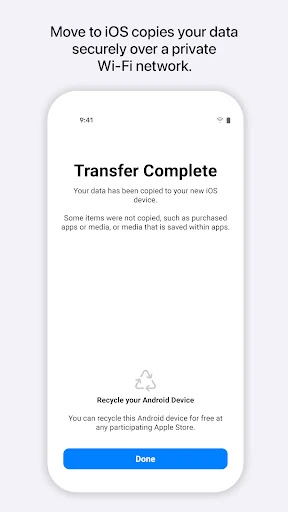
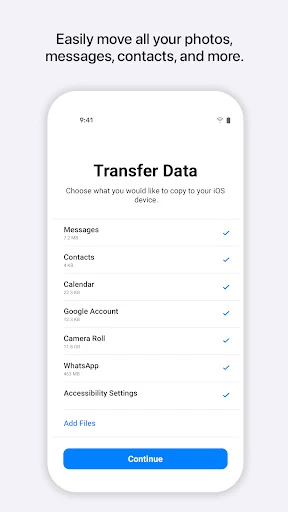
  • Automated Multi-Data Transfer: Solves the user's core anxiety of "what will I lose?" by securely migrating not just photos and contacts, but also call logs, message history, WhatsApp data, and mail account settings, theoretically reconstructing their digital environment on the new device.
  • Private, Secure Wi-Fi Connection: Directly addresses security and privacy concerns that arise when transferring sensitive personal data. By creating a private, peer-to-peer network and using a security code, it bypasses the need for cloud storage or manual cable connections.
  • Permission-Granular Optional Permissions: Provides users with control and transparency. Rather than requiring blanket access, the app clarifies exactly *why* each permission (SMS, Photos, Contacts, etc.) is needed for specific data types, respecting user privacy and allowing for partial transfers.
  • Automatic Content Placement: Solves the post-transfer organizational headache. The app doesn't just dump files; it attempts to place content "in the right places" within iOS's native apps (like Photos, Contacts, Messages), ensuring the new device is immediately usable.

🎨 User Experience & Design

From a UI/UX perspective for a critical Tools app, the design philosophy prioritizes absolute clarity and reduction of user error over aesthetic flourish. The process is heavily linear and wizard-driven, which is appropriate for a one-time, high-consequence task. The interface (as inferable from the description) likely employs clear step-by-step instructions, prominent buttons for core actions like "Start," and status indicators to alleviate the anxiety of waiting during the transfer. This approach aligns with the mental model of a user performing a system-level task who needs guidance, not exploration. However, this also means the UX is task-locked; there is no "dashboard" or ongoing utility, highlighting its single-serve purpose.

⚖️ Pros & Cons Analysis

  • ✅ The Good: It's an official Apple solution, guaranteeing deep system-level access and compatibility that third-party apps cannot match.
  • ✅ The Good: Handles a remarkably broad and complex dataset automatically, far exceeding simple file copy utilities.
  • ✅ The Good: The private Wi-Fi transfer method is both secure and convenient, requiring no intermediate cables or cloud subscriptions.
  • ✅ The Good: Granular permission requests build user trust by explaining the necessity of each data access point.
  • ❌ The Bad: The process's success is heavily dependent on a stable, direct wireless connection between two devices, which can be fragile in environments with significant Wi-Fi interference.
  • ❌ The Bad: It is a "fire-and-forget" tool with zero utility after the migration is complete, offering no ongoing sync or backup capabilities.
  • ❌ The Bad: As a bridge from Android, it inherently caters only to a one-way, one-time user journey, limiting its broader appeal.

🛠️ Room for Improvement

For the next major update, the development team should focus on robustness and user reassurance. Integrating a pre-transfer compatibility and storage space check on the target iOS device would prevent failures mid-process. A detailed, itemized post-transfer report (e.g., "452 photos transferred, 'App X' not available on iOS") would provide closure and next-step guidance. Furthermore, introducing a simple, post-migration "troubleshooting" section within the app—perhaps linking to common support articles for apps that didn't transfer—could help users fully finalize their setup without leaving the app's context.

🏁 Final Conclusion & Recommendation

This app is an indispensable, purpose-built tool with a laser-focused target audience: Android users who have purchased a new iPhone or iPad and are in the device setup phase. For this group, it is unequivocally the recommended solution over any third-party alternative. Its value proposition—turning a potentially stressful, days-long manual process into a single, secure, automated session—is immense. The final verdict is that "Move to iOS" successfully executes its complex, narrow mission, making the ecosystem leap significantly less intimidating. While it will never be a daily-use app, its impact on user satisfaction during a critical moment of device adoption is profound.