Advertisement
Click to download now, finish the installation quickly, and directly unlock the "all-round experience"
Advertisement
Screenshots


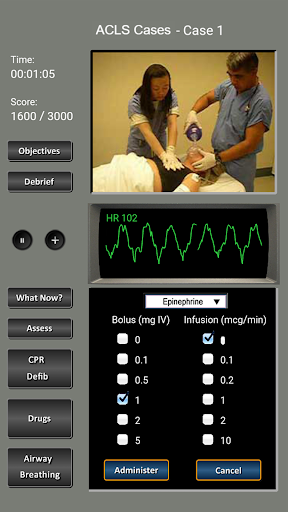


Click to download now, finish the installation quickly, and directly unlock the "all-round experience"
The ECG and ACLS Tutor app carves out a specialized and vital niche within the Medical category by focusing on high-stakes skill acquisition. This is not a general medical reference app; it is a targeted simulator and tutor designed explicitly for healthcare professionals preparing for and maintaining competency in Advanced Cardiac Life Support (ACLS). It bridges the critical gap between static textbook knowledge and the dynamic, high-pressure environment of a real cardiac arrest ("code blue"), positioning itself as an essential tool for proactive clinical rehearsal.
The interface prioritizes clarity and functionality over aesthetic flourish, which is appropriate for a serious medical training tool. The UX is built around a logical progression from learning fundamentals (Primer) to guided practice (Tutor) to assessment (Challenge) and finally to application (Simulator). This scaffolded approach aligns with effective pedagogical principles. The most significant UX strength is the dynamic ECG display, which directly mimics real-world clinical equipment, creating an immersive and highly relevant practice environment. The simulator interface, requiring user input for evaluations and commands, effectively translates the cognitive load of a resuscitation into an interactive format. For the Medical category, this focus on realism and structured learning pathways represents a superior UX compared to apps offering only passive content consumption.
Future updates could significantly enhance the app's value by expanding the case library with more rare or complex multi-factorial scenarios. Introducing a competitive or collaborative element, such as timed challenge modes or shared scenario playback for team training, could increase engagement. Adding brief video explanations for key interventions or rhythm nuances would cater to visual learners. Furthermore, a notes or bookmarking feature would allow users to flag difficult rhythms or decisions for focused review, personalizing the learning journey. Finally, exploring basic adaptive learning to tailor scenario difficulty based on user performance would make the practice even more efficient.
This app is highly recommended for its specific target audience: healthcare professionals (physicians, nurses, paramedics, students) who are required to obtain or maintain ACLS certification. It is an invaluable supplement to official courses, not a replacement. For this group, the app's rigorous, simulation-based approach to rhythm recognition and code leadership offers unparalleled practical value, directly translating to improved preparedness and confidence in real-life emergencies. The final verdict is that ECG and ACLS Tutor is a niche, expert-level training tool that excels at its core mission, making it a worthwhile investment for any serious medical practitioner.